23 - Jax and the death of the audience: a personal opinion
The release of The Amazing Digital Circus' last episode has sparked a lot of fascinating conversation just hours after release, mostly revolving around the character Jax and what her (or his) story means in that last episode. I'll try not to post spoilers at all here, but if you haven't watched it (and you're the type who enjoys watching independent animation), now's a great time to catch up on The Amazing Digital Circus in my opinion.
It did (at least on Bluesky, I care about my mental health too much to want to know what people on other social media sites think) spark a lot of discussion about subtext, media literacy and something people brought up about "death of the audience". I assumed it's an antithesis of "death of the author", a something that speaks about the abysmal state of how we read, process and interpret a work of art. And to be fair, this mostly started coming into mind because of this hilarious post:
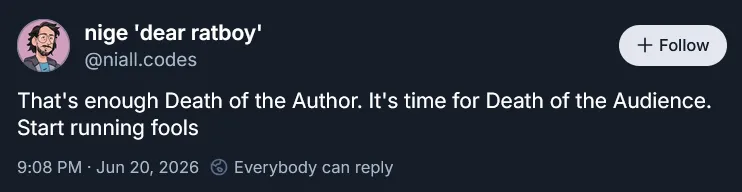
I've since learned it isn't an entirely new concept that came about just recently; in fact it has been a subject explored - albeit infrequently - through various art forms, though from my rudimentary research it seems to be more common in theater and the performing arts. And I suppose it's understandable, considering theater, ballet, opera and other such forms of performing art is an art that requires an audience the most - for them to be present, to be immersed in the performance before them - and after the curtains fall, to walk out of the theater to discuss and discern what it means?
Now I'm just going to be honest here: I'm hardly qualified to write about any of this. My highest academic qualification that I actually earned is about the equivalent of a high school diploma. But one thing I enjoy is reading, learning about and researching topics like this. It's fun, and I do like learning about new things. That being said, I thought it was interesting that it isn't an entirely new topic of exploration, but more than that, I also find it interesting that this random bluesky post has been used as a stepping stone for some very important discussions about the way we (the so-called audience) interact with art.
I think anyone who's enjoyed any kind of art (books, movies, games, even literal theater) can attest to how starting & taking part in discussions about said art have been, in the past few years especially, the equivalent of inflicting yourself with significant psychological damage. It seems like the larger consensus for some reason has been "why didn't the author/creator of this body of work spell out what they meant to convey straight up?" This either manifests in "why didn't they just make this [popular headcanon that a majority of the audience adopted because a few people were very convincing in their interpretation of something] canon?" or "why is it so hard to make [insert a queer character who isn't explicitly stated that they're queer] more obviously queer??" and so on and so forth. You've probably heard something like this a million times over, and I'm sure you're a little sick of the demands that art, somehow, needs to be spelt out to the wider audience in favor of things having little to no room for "incorrect interpretations".
From my perspective, it's a bit amusing (and scary) how people - at least within online spaces - have been viewing art in the same lens as many people view religion - that there's only one "correct" way to interpret a work of art and its messages, and everything else sounds like blasphemy in comparison. Equally difficult is to resist the trap of falling into this kind of mindset; the assumption that divine punishment awaits you if you ever so much as say something that goes against the norm IS scary, so it's safer to either just be quiet or simply adopt the same thing. Getting doxxed or harassed to the point of suicide over fiction sounds ridiculous, but it can be frightening as fuck when it happens to you or someone you care about. It's not so different from when you're being shamed en masse by your church or the "tarbiah sentap" of your local mosque's Friday sermon, when you think about it: humiliating, frustrating, makes you think there's little room for you to find the meaning of the work you enjoy in your own ways, little room for you to question things and derive meaning from it.
To be clear, when I talk about interpretations of fiction-as-religion I'm not talking about the overt or the blatant here; for example if a character is, say, explicitly stated to be queer or BIPOC (or both), of a certain religion etc, or if there's little to no room for that character to be interpreted otherwise within a work of art created by a marginalized person, then trying to argue otherwise not only accomplishes little but it also just makes you look like a joke. What I'm talking about is the art of subtext, when the artist deliberately chooses to provide clues rather than just state something outright, to show rather than tell and to trust that the audience would see these little (or huge) morsels of their intended message and have their "AHA" moment.
But how would you, the artist, feel when the audience instead points pitchforks at you and demand you tell them what YOU think about your own work and hinging on your every word as the Word of God? How would you feel when you realize the audience simply doesn't want to do the work (or derive joy) from interpreting your work as you'd like them to, but rather demand that it's much easier (some even say, for some weird as fuck reason, accessible) for you to just spell it out and spoonfeed it to them? We know that social media and a worryingly growing intolerance on the internet has bolstered a sense of idiotic entitlement in a lot of people, and in many ways this is a direct consequence of the lack of arts education in my opinion; I just find it very frustrating that it's permeated into how we view, interpret and interact with all art.
I don't know about anyone else reading this post. I like deriving my own meaning and interpretation from the work I enjoy and talking about it with like-minded people. I like theorizing, I like expanding the lore. I don't really need the author to tell me everything from A to Z about their work and the expansive world behind it. It's always a treat when someone whose work I admire does that out of passion, but if they'd rather send their message differently, then there's no reason for me to interrogate with such zealous scrutiny for a hint of confirmation. I'm comfortable with guessing the intent and the meaning behind it. Perhaps in that sense, maybe in this day and age the death of the audience is necessary to ensure art is sustainable in the long run.
So if you're who's just unwilling to do the work and derive your own meaning in the art you enjoy: start running.
Some further reading:
Does Art Belong to Its Audience or Its Creator? by Laura Lee
Artspeak and Audience: Art Writing as Bridge or Barrier by Cara Ober
Who Killed the Audience? And Can We Get Them Back? by Susan Dabbar
The Death of the Reader: Meaning in the Era of Digital Narcissism - paper by Massimo Leone of the University of Turin
The Death of the Audience: A Conversation with Pierre Bal-Blanc by Élisabeth Lebovici
(If you've got other articles, interviews, or books about this topic that you think I should add feel free to e-mail me!)